Congressional Voting: Direct Democracy on the Blockchain
How the Martian Republic's congressional voting system works — proposal submission, voting mechanics (Yes/No/Abstain), CoinShuffle ballot privacy, voting periods, 51% threshold, and proposal categories from Constitutional to Science.
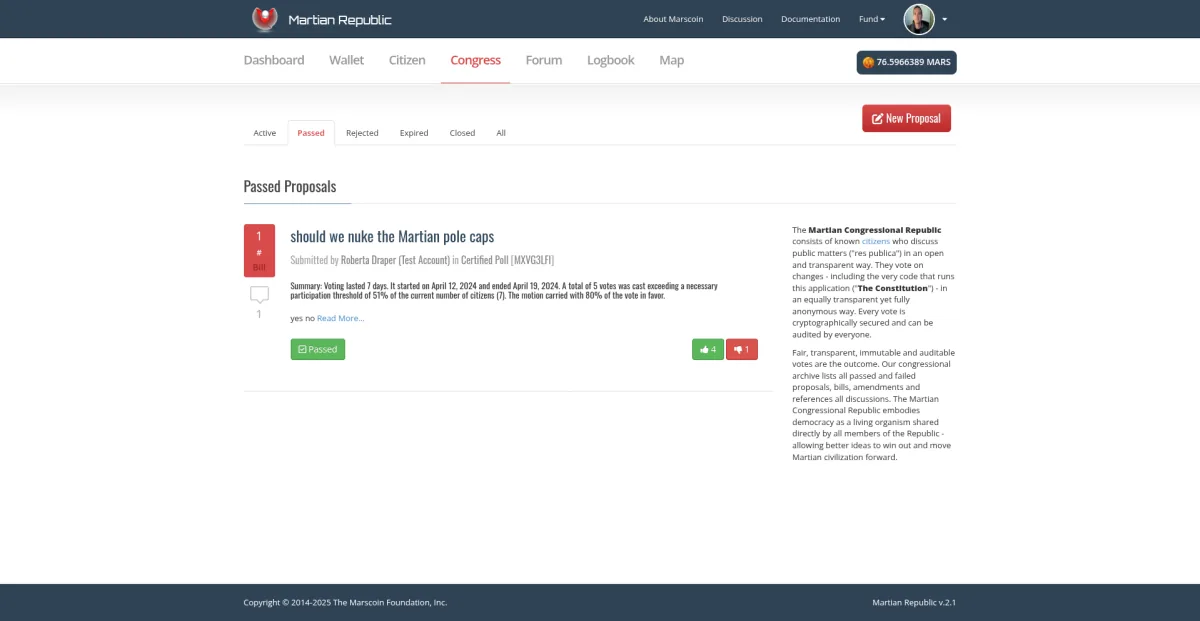
The Case for Direct Democracy on Mars
Representative democracy was invented to solve a scaling problem. When millions of citizens cannot all gather in a single forum to deliberate, they elect representatives to deliberate on their behalf. It is a pragmatic compromise — trading direct participation for logistical feasibility.
A Mars settlement does not have this scaling problem. With a population of dozens to hundreds of people, every citizen can meaningfully participate in every decision. The question is not whether direct democracy is desirable — in a small, high-stakes community where every decision affects everyone, it clearly is — but whether it can be implemented securely, privately, and efficiently.
The Martian Republic’s congressional voting system demonstrates that it can.
How a Proposal Is Born
Any verified citizen of the Martian Republic can submit a governance proposal. The process is straightforward:
Drafting the Proposal
Through the Martian Republic application, a citizen creates a proposal that includes:
- Title — a concise summary of what is being proposed
- Description — a detailed explanation of the proposal, its rationale, and its expected impact
- Category — one of seven defined categories (described below)
- Voting period — the duration for which the vote will remain open, between 1 and 30 days
- Supporting materials — optional documents, data, or references stored on IPFS and linked by hash
Submission to the Blockchain
When the citizen submits the proposal, it is recorded as a transaction on the Marscoin blockchain. This creates an immutable, timestamped record of what was proposed, by whom, and when. The proposal cannot be altered after submission — what was put to the community is permanently recorded.
The IPFS hash of the full proposal text is included in the blockchain transaction, ensuring that the complete proposal (which may be too large to store directly on-chain) is permanently linked and verifiable.
Opening the Vote
Once the proposal is on-chain, the voting period begins. All verified citizens are notified through the Martian Republic app and can review the proposal, discuss it in community channels, and cast their vote.
Voting Mechanics

The Ballot
Each citizen has three options:
- Yes — support the proposal
- No — oppose the proposal
- Abstain — acknowledge the proposal without supporting or opposing it
Abstentions are counted in participation metrics but do not affect the outcome calculation. This is an important distinction — a citizen who abstains is expressing engagement without commitment, which is different from not voting at all.
One Citizen, One Vote
The on-chain citizen registry ensures that each verified citizen can cast exactly one vote per proposal. The system checks the voter’s public key against the registry of verified citizens (those who have achieved full citizen status through the peer attestation process) and rejects votes from unregistered keys or duplicate votes from the same key.
This is not a token-weighted system. Regardless of how much MARS a citizen holds, their vote carries equal weight. The Martian Republic is a democracy of persons, not of capital.
CoinShuffle Ballot Privacy
Here is the hard problem: on a public blockchain, where every transaction is visible to everyone, how do you keep votes secret?
Ballot secrecy is not a luxury. In a small community where people live and work together, the social consequences of vote disclosure can be severe. If everyone knows how you voted on a contentious resource allocation proposal, personal relationships and professional dynamics can be damaged. The chilling effect on honest voting is real and well-documented in political science research.
The Martian Republic solves this with CoinShuffle, a decentralized mixing protocol that achieves ballot secrecy without requiring a trusted third party.
How CoinShuffle Works for Voting
-
Key Exchange. All participating voters share ephemeral public keys specifically generated for this vote.
-
Layered Encryption. Each voter encrypts their ballot in layers, like an onion. The outermost layer is encrypted with the last participant’s ephemeral key, the next layer with the second-to-last participant’s key, and so on through all participants.
-
Sequential Shuffle. Participants process the encrypted ballots in sequence. Each participant decrypts their layer (removing one layer of encryption) and randomly shuffles the order of all ballots before passing them to the next participant. After every participant has processed the batch, all encryption layers have been removed and the ballots are in a completely randomized order.
-
Public Tally. The fully decrypted, shuffled ballots are published. Anyone can count them and verify the result, but no one can trace any ballot back to the voter who cast it.
Why This Works
The critical insight is that shuffling breaks the link between voter and ballot. Even if an attacker controls some participants in the shuffle, they cannot deanonymize ballots unless they control all participants — a practical impossibility in a system with many voters.
The entire process is recorded on the blockchain, so it is fully auditable. Any citizen can verify that the protocol was executed correctly, that only eligible voters participated, and that the final tally matches the decrypted ballots. Secrecy and verifiability coexist.
Voting Periods
The proposer selects a voting period between 1 and 30 days when submitting the proposal. The choice of period reflects the urgency and gravity of the decision:
| Duration | Typical Use Case |
|---|---|
| 1-3 days | Emergency decisions requiring rapid response |
| 7 days | Standard operational decisions |
| 14 days | Significant policy changes |
| 21-30 days | Constitutional or fundamental governance changes |
Shorter periods are appropriate when the community needs to act quickly — for example, an emergency reallocation of water reserves after equipment failure. Longer periods allow more time for deliberation, discussion, and considered judgment on decisions with lasting consequences.
The voting period begins when the proposal transaction is confirmed on the blockchain and ends at the block height corresponding to the specified duration. Block-based timing ensures that the deadline is deterministic and cannot be manipulated.
The 51% Threshold
A proposal passes if it receives Yes votes from more than 51% of participating voters (excluding abstentions). This simple majority threshold is a deliberate design choice:
- It is decisive. Unlike supermajority requirements (which can create paralysis), a simple majority ensures that a clear preference among participants translates into action.
- It is familiar. Most democratic systems use simple majority for ordinary decisions, making the system intuitive.
- It respects participation. The threshold applies to voters who actually participate, not to the total citizen population. This prevents a small minority from blocking decisions by not participating.
For example, if a proposal receives 30 Yes votes, 25 No votes, and 5 Abstain votes, the outcome is calculated from the 55 non-abstaining votes: 30/55 = 54.5%. The proposal passes.
If the community determines that certain categories of decisions should require higher thresholds (such as a two-thirds supermajority for constitutional changes), this can itself be established through a governance proposal.
Proposal Categories
Every proposal must be assigned to one of seven categories. Categories serve both organizational and procedural purposes — they help citizens filter and prioritize proposals, and they may eventually carry different procedural requirements (such as different quorum or threshold rules).
Constitutional
Proposals that would amend the fundamental rules of the Martian Republic itself. These are the highest-stakes decisions: changes to the citizenship process, voting mechanics, rights protections, or the structure of governance. On Earth, these would be constitutional amendments.
Example: “Increase the attestation threshold for citizenship from 3 to 5 existing citizens.”
Governance
Proposals related to the administration and procedures of the republic. These are the operational rules — how governance itself functions, without changing the underlying constitution.
Example: “Extend the default voting period for non-emergency proposals to 14 days.”
Economics
Proposals related to the financial system, monetary policy, resource allocation, and economic rules. On Mars, this category will be existentially important — every economic decision has implications for survival.
Example: “Allocate 500 MARS from the community fund to support development of the water recycling monitoring system.”
Infrastructure
Proposals related to physical or digital infrastructure — habitats, power systems, communication networks, software systems, transportation, and construction projects.
Example: “Approve construction of a secondary greenhouse module in the northeast quadrant of Olympus City.”
Safety
Proposals related to emergency protocols, safety procedures, environmental hazards, health policies, and risk management. On Mars, safety decisions can be life-or-death.
Example: “Implement mandatory EVA buddy system for all surface operations beyond 2 km from the habitat.”
Social
Proposals related to community life, social norms, cultural events, education, and interpersonal policies. These are the decisions that make a settlement a society, not just an outpost.
Example: “Establish a weekly community assembly for open discussion of non-urgent matters.”
Science
Proposals related to scientific research priorities, data sharing policies, experiment approvals, and the allocation of research resources. Science is the primary mission of early Mars settlement.
Example: “Prioritize subsurface ice mapping in the Jezero crater region during the next 30-sol research cycle.”
The Lifecycle of a Vote
To summarize the complete lifecycle:
- Proposal submitted — a citizen publishes a proposal on-chain, specifying category, voting period, and supporting materials
- Discussion period — citizens review, debate, and form opinions through community channels and the app’s feed
- Voting opens — the CoinShuffle protocol is initiated, and citizens cast encrypted ballots
- Voting closes — the voting period expires at the designated block height
- Shuffle and decrypt — the CoinShuffle protocol completes, producing decrypted, anonymized ballots
- Tally and result — votes are counted publicly; if Yes votes exceed 51% of non-abstaining votes, the proposal passes
- Permanent record — the proposal, participation data, and result are permanently recorded on the blockchain
Every step is transparent, auditable, and decentralized. There is no election commission, no returning officer, no authority that can delay, alter, or suppress results. The protocol is the authority.
Why This Matters
The Martian Republic’s voting system is not an experiment in blockchain technology for its own sake. It is a pragmatic response to a real problem: how does a small, isolated community govern itself without inherited institutions?
The answer is that they build the institution into the code. The rules of democracy — eligibility, secrecy, fairness, verifiability, finality — are not social agreements that depend on trust and goodwill. They are cryptographic properties enforced by mathematics.
This does not eliminate politics. People will still disagree, form factions, lobby for their positions, and compromise. What it eliminates is the infrastructure of corruption — the ballot boxes that can be stuffed, the counts that can be falsified, the eligibility rolls that can be manipulated. On Mars, where the stakes are survival, this is not an abstract benefit. It is a necessity.
To understand how citizens are verified for voting eligibility, see The Citizen Registry: Decentralized Identity on Mars. For the full governance architecture, see The Martian Republic: Blockchain Governance for Mars. For the cryptographic foundations, see the Marscoin Whitepaper.